Art Hack Day
January 28th was Art Hack Day at 319 Scholes in New York, an exhibit of projects by artists and hackers created within 48 hours each. The purpose of Art Hack Day is to bring together "hackers whose medium is art and artists whose medium is technology." Exhibits include moss graffiti, cut with a high powered laser printer; a photo booth that created animated gif images and showed them in midtown; a makerbot, or 3D printer; haiku's written with wifi; bike-powered movies; and interactive video games. The work is innovative, exciting, fresh, and unlike anything I've been exposed to before. Seeing this article is part of what inspired me to do my weekly art project digitally, through code.
I find this work inspiring and encouraging. Being a student focused on learning the history of art, I often feel I lose context with the modern. In a world where technology and art are often separated with an iron curtain, seeing people actively combining them reminds me that I don't have to purge myself of modern influences to create art. I hope to continue incorporating technology into my work, thinking of new ways to view the technology we use everyday, ways to see it as a mode for art.
Here's a link to an online gallery of the projects!
Stephen Colbert superPAC raised over 1 million dollars
Comedy Central ‘news anchor’ Stephen Colbert is known to have a strong following, but it is still shocking that he could raise 1 million dollars for a superPAC. As Peralta for NPR reports, “this is all satire,” but profound and powerful satire. With the money, Colbert has created multiple ads to influence the republican primaries, such as promoting Herman Cain in South Carolina, after he had dropped out of the race, and running ads which linked Mitt Romney to being a serial killer. (Watch the ad here.)
Colbert says of the money, “We raised it on my show and used it to materially influence the elections — in full accordance with the law. It's the way our founding fathers would have wanted it, if they had founded corporations instead of just a country.” How the remaining money will be used is yet to be determined.
Tuesday, January 31, 2012

Monday, January 30, 2012
Breaker Box
I tried something very different for my art project this week. With some help from my Dad, I created an interactive game, which I would love to expand and use as a commentary on social media websites like facebook, although this goal may be a little out of my reach at the moment.
 All the drawings for the game were drawn by me in Photoshop, the HTML and CSS were written entirely by myself, and the Javascript, which is the real magic, was a collaboration between me and my Dad, Mike. I really enjoyed working on this, and would like to continue learning about javascript and creating interactive drawings and images.
The game is simple: find a way to exit the room. I wanted to start with a very simple objective and 'plot' and hope to create more complicated problems and solutions which span multiple rooms in a house. I also plan to incorporate more plot elements to create a more atmospheric experience.
Give it a shot here, and let me know if you find bugs, have suggestions, questions, or other feedback!
The game is simple: find a way to exit the room. I wanted to start with a very simple objective and 'plot' and hope to create more complicated problems and solutions which span multiple rooms in a house. I also plan to incorporate more plot elements to create a more atmospheric experience.
Give it a shot here, and let me know if you find bugs, have suggestions, questions, or other feedback!
Tuesday, January 24, 2012
Suffer for Fashion

I didn't have plans going into the project, but I kept finding really dark and violent images populated by waif-like models, so I collected the images and collaged them together. I knew the collage would be time consuming, searching for materials and cutting out the details, but it ended up taking longer than expected (doesn't everything?). The process reminded me of photomanipulation in photoshop, and taking my own photos and editing/painting them digitally is a project I might try later in the semester.
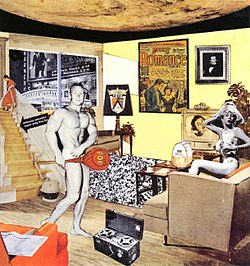
The idea for collage came from Richard Hamilton, a member of the Independent Group, who created collages from American advertisements such as Just What Is It That Makes Today's Homes So Different, So Appealing?
Week 2
Art
Lichtenstein Lawsuit for GagosianI saw this headline and it caught my attention. I'm taking a Pop Art and Fluxus class, so Lichtenstein has been coming up a lot in my reading. Apparently, the Gagosian Gallery in New York is being sued by an art collector, Joan Cowles, over a Lichtenstein painting. The collectors son sold the painting without her consent to the gallery, who then sold it for 2 million dollars, reportedly less than it's market value, and now the collector is sueing Gagosian for 10 million dollars and accusing the gallery of "such wanton dishonesty as to imply criminal indifference to civil obligations, with reckless disregard of Cowles’s rights." The gallery denies the accusations and claims that they did not know at the time of purchase that the son did not have permission to sell the painting.
A lot of our discussion in the Pop Art class has centered around the distinction between Pop Art, with a capital P, and commercial (popular) art. The Smithson’s called for fine art to compete with pop art, and perhaps this means appropriating the qualities of pop art. I think the commercial success of Pop Art proves that it did just that, but the comodification of these artworks also brings into question whether they can be considered Fine Art objects at all.
Thinking
The Birth Of TragedyIn preparation for the lecture on Thursday, I read the introduction of Nietzsche's The Birth Of Tragedy. The link includes the whole text. The central idea proposed by the text is that art is motivated by two factors, personified by Greek gods. Apollo becomes Apollonian art, or the plastic arts, and Dionysus becomes the Dionysian, paired with music. Greek tragedy marries the two forces to create ideal art. Nietzsche explains the two forces as dream and intoxication as well. Apollonian arts emerge from the fantastic, idealized dreams of the artist. Apollo, the god of brightness, is also the god of fantasy. The Dionysian then is linked with intoxication. He associates this with the “tremendous awe which seizes a man when he suddenly doubts his ways of comprehending illusion.” The Dionysian is a more spiritual experience with nature, and life. Active and emotional next to the controlled intelligence of the Apollonian.
Nietzsche claims that the best art marries these two forces, and the most successful marriage of the two is in fact the Greek Tragedy. He acknowledges both as art, but believes that one without the other is less valuable than both.
Social Change
ACTA SummaryACTA Video
After all of the hype over SOPA and PIPA which failed in congress last week after major sites like Reddit, Wikipedia, Imagur, and Craigslist went black for 12 hours in protest, the internet is turning to an older bit of legislation, ACTA, which would be implemented on a larger scale. The summary (which is, ironically, from Reddit) includes a link to the source material, gives an overview of the bill, focusing on what it would actually do. The author of the post emphasizes the fact that what makes the bill dangerous is not what it legislates, but what it would allow governments to legislate. Under ACTA, bills like SOPA and PIPA would be able to be passed.
The hype ACTA is recieving is misleading. While it is dangerous, and definitely compromises free speech and file sharing, and having farther reaching consequences in farming and healthcare, the bill itself does not implement anything, it simply makes it possible to. The video is very well made, but I don’t think it is particularly informative. It provides ‘what if’ scenarios, but does not adequately explain how the bill works to enable these possible scenarios. I will pursue these issues in further posts.
Thursday, January 19, 2012

Week 1
ART
Modern Art Improves Quality of Life for Alzheimer's PatientsLooking at art can improve the quality of life for people with Alzheimer’s, studies show, because patients continue to have emotional responses to art, which trigger memories. The program was started at the MoMA in 2006, with tours of all Alzheimer’s patients. It was part of an initiative to reach underserved audiences, such as the deaf and blind. A keynote speaker at a summit held to create the program encourages us to “stop thinking about Alzheimer’s as a death sentence, and start looking at it as we would any other chronic condition.” On the tours, Alzheimer’s patients are not treated as a special needs group, and the action of looking at art helps them recall memories, which increases their quality of life.
This article reminds us that there is something about art which encourages creative thinking and establishing connections. Viewing and discussing art is beneficial for everyone, and it is unfortunate to see it constantly cut from school programs. It’s great to see research and instances which remind us of the importance of art.
THINKING
Waking Life Since this movie covered a lot of ground, I’m picking out one of my favorite scenes and going from there. I like this scene, because it points out what a lot of people ignore when they talk about science and religion. People tend to pit the two against each other, when really, they have a lot in common. They both seek to understand how the world works, and in the case of free will they both struggle to explain it. Religion fails to explain free will in the face of an omnipotent God, and physics fails to explain free will in a world of predictable chemical and physical reactions.
The speaker explains, simply, how our movements are controlled; electrodes fire in the brain and send a pulse through the nervous system, which causes a muscle to contract. He states that each of these actions and reactions can be explained with basic physics. I don’t know enough about it myself, but I would be interested to see what starts the chain in the brain. I guess that’s the tricky bit, because that’s when we, make decisions. Or are all of our actions simply reactions to the problems placed in front of us. What about thoughts, which never manifest themselves into actions?
SOCIAL CHANGE
“Information Diet” on NPR“If we want to make media better, then we've got to start consuming better media,” says Clay Johnson, author of “Information Diet.” I saw this headline on NPR’s front page, and was immediately interested in how Johnson was able to transpose the language and logic of obesity and dieting onto the consumption of media. It’s a really straight forward interview, and I think this line of thought is especially important in the Internet age, when we, the consumer, have the power to choose what we watch, see, and hear online. We are not limited to the two news stations we get on our television, and the paper that comes every morning. (In fact, I don’t think I know anyone my age who regularly watches news on TV or gets a newspaper daily). We get our news online, via twitter feeds, facebook, and reddit. Johnson explains how media sources cater to the desires of their readers, which often comes at the cost of quality, informed news stories. If we want better news, we have start looking for better news. Stop sifting through ads, and clicking on the first thing that catches your attention. Johnson suggests staying as close to the source, and as far from opinion, as you can. For example, if looking at legislation, try to find the bill instead of reading someones opinion on the bill.
Subscribe to:
Posts (Atom)