The NCAMCT is a mock standardized test meant to illustrate the downsides of multiple choice testing, by limiting creativity by discouraging negative capability, and the tedium of multiple choice answers.
You can download the powerpoint as a PDF for your ow printable copy, although you won't be able to bind it properly without changing the order of the pages.
Saturday, April 28, 2012

Beyond Binary
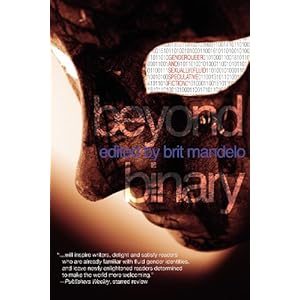
Beyond Binary: Genderqueer and Sexually Fluid Speculative Fiction is an anthology of speculative fiction which explores sexual fluidity. The anthology was edited by Brit Mandelo, a student at UofL who just finished her undergrad and is continuing on with her masters here at the university. She had a book release party on campus, where she sold copies of Beyond Binary and her recently published thesis We Wuz Pushed, on Joanna Russ.
The release included the editor, Brit, reading the introduction and explaining a bit of the process of putting the anthology together, and her reasons for doing so. After her introduction, she opened the floor for questions. After the Q and A, Brit sold copies of her books and signed them. I have read the first few stories of the anthology and have enjoyed all of them. They are rich and diverse, representing more than (so much more than) the simply hetero-normative romance and sex we see in mainstream media. Speculative fiction is a great way to represent, and introduce, these 'counter-culture' ideas of relationships and sex, because it allows for infinite possibilities and complete immersion.
Thursday, April 19, 2012
Jane Mai
janemai.tumblr.com
artists website

Jane Mai is a Pratt Institute graduate living in Brooklyn, NY. She creates her own comics, zines, and t-shirts as a freelance illustrator. Her work is often humorous, in a cynical and sarcastic kind of way, made more so by the childlike and simple style of her drawings. Jane Mai's comics are journalistic and personal, depicting scenes from her own life which read like diary entries. She also runs an 'advice blog' on tumblr, where people ask questions about anything and she gives hypothetical and often humorous advice.
I like Jane Mai's work because she has effectively taken her life and turned it into art. Her work is about her life, in a very direct way. She's painfully honest, at times addressing subjects that could be considered 'taboo' by society at large, without any apologies. She confronts issues of sex and gender as they appear in her life. When I look at her work, and see her doing something so honest and seeing people respond to that I find it comforting. Perhaps I could be that honest with my work one day.
artists website
Jane Mai is a Pratt Institute graduate living in Brooklyn, NY. She creates her own comics, zines, and t-shirts as a freelance illustrator. Her work is often humorous, in a cynical and sarcastic kind of way, made more so by the childlike and simple style of her drawings. Jane Mai's comics are journalistic and personal, depicting scenes from her own life which read like diary entries. She also runs an 'advice blog' on tumblr, where people ask questions about anything and she gives hypothetical and often humorous advice.
I like Jane Mai's work because she has effectively taken her life and turned it into art. Her work is about her life, in a very direct way. She's painfully honest, at times addressing subjects that could be considered 'taboo' by society at large, without any apologies. She confronts issues of sex and gender as they appear in her life. When I look at her work, and see her doing something so honest and seeing people respond to that I find it comforting. Perhaps I could be that honest with my work one day.
Sunday, April 8, 2012
Mathilde Roussel
http://www.mathilderoussel.com/
 "The natural world, ingested as food becomes a component of human being. Through these anthropomorphic and organic sculptures made of soil and wheat grass seeds, I strive to show that food, it’s origin, it’s transport, has an impact on us beyond it’s taste. The power inside it affects every organ of our body. Observing nature and being aware of what and how we eat makes us more sensitive to food cycles in the world - of abundance, of famine - and allows us to be physically, intellectually and spiritually connected to a global reality."
Mathilde Roussel is a French artist, who works sculpturally. For each of her projects, she also creates drawings as a part of her process which could be considered works of art in themselves. This particular piece is a series of anthropomorphic shapes made out of soil and wheat grass seeds, a commentary on our relation to the environment.
Mathilde Roussel is a French artist, who works sculpturally. For each of her projects, she also creates drawings as a part of her process which could be considered works of art in themselves. This particular piece is a series of anthropomorphic shapes made out of soil and wheat grass seeds, a commentary on our relation to the environment.
Chip Kidd gives a TED talk on how book covers can tell a story. He does this by telling stories about his book covers. I clicked on this video because of Katie's presentation, and was not disappointed in Kidd's presentation. He is entertaining to listen to, and has great insights into design and the relationship between form and content. His story telling is fun to listen to, and informative.
Musicircus

The music was interesting to hear, but I thought the presentation of the musicians and their playing could have been better. The room with the musicians featured a random visualization, which was interesting to watch, but I felt detracted from the musical performance. If the visualization had been somehow generated based off the music as it was played, I would feel slightly differently. Regardless of the visualization, which on its own would not have bothered me, the musicians sat facing the screen and not the audience. I could not see their instruments well, or what they were doing to produce the sounds they were making. I would have liked to see them facing each in a circle, or facing the audience. Small critiques for an otherwise great show, glad to see Cage's work getting more attention from visual artists.
Sunday, March 25, 2012
Richard Tuttle


I saw Richard Tuttle's water color drawings while visiting the Speed Art museum this weekend. I went with a friend to see the impressionist exhibit, but on the way out we found a room of minimalist and postminimalist work, including Frank Stella, Sol LeWitt, and Richard Tuttle. I had never heard of Tuttle, but his drawings drew me in immediately. He does multiple series with this process, using notebook paper and small amounts of watercolor applied randomly, and displays them as a group.
The work is about the choice of materials, the notebook paper which is typically avoided as a surface for fine art, and the non representational and chance application of the watercolor, almost imitating a spilled drink. The pieces have an accidental and effortless feel, while being entirely intentional on the part of the artist.
Train
GDC 10: the Holocaust board game

"Brenda Brathwaite's Train is a table top game that teaches the player about the Holocaust through simple, effective game design."The game Train exists in the nebulous space between board game, art, and social teaching tool. The game is beautifully designed, aesthetically, to reflect the subject material and present only information that is useful to the game's end.
The goal of the game is to fill a car with as many passengers as possible and deliver them to an unnamed destination. You are the train conductor, trying to get all your passengers to the destination safely. When you've reached the destination, you select a card with tells you where you've just delivered your passengers. "Dachau." "Auschwitz."You have just delivered a train full of passengers to a nazi concentration camp. This moment of revelation is really the point of the game, and how the game is handled from this point on reveals the level of understanding the players have. Most players do not mention their destination to the other players, suggesting they are either embarrassed or do not want to ruin the surprise.
The point of creating the game around this reveal is that you have been looking at the game up to this point impersonally. You are a player with a goal, and you do not question the motives for the goal. You participate in a types of systemized killing without having to actually participate. It provides a point of understanding as to how something like this can happen, and how different reactions can then be justified. One woman continued to play, insisting that the train conductor probably had a family to feed and had to keep working in order to keep them alive.
Final Project
"Several things dove-tailed in my mind, and at once it struck me what quality went to form a Man of Achievement, especially in Literature, and which Shakespeare possessed so enormously - I mean Negative Capability [emph added], that is, when a man is capable of being in uncertainties, mysteries, doubts, without any irritable reaching after fact and reason - Coleridge, for instance, would let go by a fine isolated verisimilitude caught from the Penetralium of mystery, from being incapable of remaining content with half-knowledge. This pursued through volumes would perhaps take us no further than this, that with a great poet the sense of Beauty overcomes every other consideration, or rather obliterates all consideration."
-John Keats
For my final project, I am going to develop an online work which confronts Keats' theory of Negative Capability and what it means in relation to the structure of the education system today. Negative Capability is the ability to withhold judgement, being able to persist in uncertainty, as opposed to immediately categorizing and assigning meaning to a person, concept or work.
The ability to persist in uncertainty is extremely valuable in creative pursuits such as art, literature, and science, but it is not something that is currently encouraged by the education system in America. Using this concept, and research about the inefficiencies of multiple choice tests, I am going to construct a reading comprehension test which points out the importance of Negative Capability and also demonstrates the inability of our current education system to teach it.
Thursday, March 15, 2012
Visual Sociology
After the lecture by Jon Rieger last class, I decided to do some research of my own house and neighborhood over the last twenty years. I leafed through my family photo albums and found a couple of photographs I could re-take to talk about the change in my home and neighborhood over the last 20 years. This project is very incomplete, I could spend forever looking through all of the photographs of my house and street and retaking them, but here are a couple I did take the time to put together.
The first photos are both from 1992, the second photos are fron 2012. I tried to find some from 2002, but we don't have as many photographs from that time period.


My mom probably won't be happy to see the top photo comparison, she hasn't done her spring gardening yet, and in general my parents are so busy they don't have the time and energy to garden and landscape as much as they did when we were younger. Also, the seasons in the photos are different, and so are the weather conditions. From these, it makes the neighborhood look extremely bleak. It's true that the neighborhood is not as lively as it used to be, but these photos are a bit misleading.
The first photos are both from 1992, the second photos are fron 2012. I tried to find some from 2002, but we don't have as many photographs from that time period.


found art

I opened up my used copy of Toni Morrison's Beloved for the first time the other day and found that a previous owner had left a photograph in the book. I think it's interesting the things you leave behind, and although I know no one in this photo, I feel like I can construct a narrative based on the photo, the fact that it was forgotten, and the fact that they returned Toni Morrison's lovely novel.
Tuesday, March 13, 2012
Susan Cain on Introversion
Following my post on Aron Wiesenfeld, who emphasized solitude and independence in his creative process, this video touches on the same subject but comes at it from a more social angle. Being an introvert in our society is a bit difficult, as we are expected to act like extroverts in order to be successful. Introverts are a little under half of people, but that's a large group to be discriminating against socially. I've definitely felt insecure about my introversion, which is different from shyness. In fact, I wouldn't say I'm very shy at all, but I'm very introverted. But I feel like I have to project myself as an extrovert, otherwise I'll be labeled standoffish or somehow unfriendly.
Susan Cain also discusses how the current model of 'groupthink' is debilitating to the creative process. Because yes, we are all more creative when we are left alone. When placed in a group setting, you will unintentionally behave differently because of social programming. Cain suggests that this new paradigm of group work, in schools and in the business world, is ineffective and should be reconsidered. That's not to say working with a group is not an essential part of the creative process, but that it is currently overused to the point that it is crippling the process.
Aron Wiesenfeld
http://www.aronwiesenfeld.com/
The drawings and paintings of Aron Wiesenfeld depict solitary figures in bleak, silent spaces. His work is about individuality and finding your self. For the young, innocent characters in his work it's a coming of age, an initiation into adulthood. Of his own work Wiesenfeld says, "It's my personal feeling, that I need to sequester myself away from external influences to be able to hear my own voice. It has been necessary to do that in order to become an artist and do work that is really mine. My experience has been that other people, even the ones with the best intentions, have their own ideas about what I should be doing, plus the world is full of ideologies that will push and pull you. I think that's part of where that story in my work comes from, which is about removing oneself from society to become a sovereign person."

His work is interesting to me because of this narrative, and because of what it suggests about creativity. That creativity is something which performs best in solitude, outside of the impressions and stresses of others.
The drawings and paintings of Aron Wiesenfeld depict solitary figures in bleak, silent spaces. His work is about individuality and finding your self. For the young, innocent characters in his work it's a coming of age, an initiation into adulthood. Of his own work Wiesenfeld says, "It's my personal feeling, that I need to sequester myself away from external influences to be able to hear my own voice. It has been necessary to do that in order to become an artist and do work that is really mine. My experience has been that other people, even the ones with the best intentions, have their own ideas about what I should be doing, plus the world is full of ideologies that will push and pull you. I think that's part of where that story in my work comes from, which is about removing oneself from society to become a sovereign person."
His work is interesting to me because of this narrative, and because of what it suggests about creativity. That creativity is something which performs best in solitude, outside of the impressions and stresses of others.
Next Generation Weather Alerts
Tornado Tech: What if Dorothy Had A Smart Phone?
After waiting out the storms in the third floor of my rickety apartment in Old Louisville last weekend, this article caught my eye. My apartment does not have television installed, and I remember searching online trying to find a decent stream showing live weather conditions and trackers, just so I could have a basic knowledge of how the storms were progressing and how much I should be worried. The university provides text alerts for when storm alerts are issued, so this seems like the next logical step.
The article mentions radios which are placed in the home to warn for alerts, because the siren systems are intended to warn those outside, and cannot be heard inside many newer homes. Tornado season is just starting, and we've already seen the damage it can do here and in southern Indiana. Laura Meyers, a researcher, confirmed that I was not in the minority as I surfed the web looking for more information." [People] wanted additional confirmation," Myers says. "They wanted to know they were directly in the path of the storm. If they got it through the television, then they checked their radios. They checked their smartphones. They called people. Many people went outside to see if they could see it coming."
Moving beyond the radios, there is, of course, an app which can be purchased for $10 for your smartphone. Personally, I think I should be able to get access to weather information for free, but if the app is good enough I would consider purchasing it.
After waiting out the storms in the third floor of my rickety apartment in Old Louisville last weekend, this article caught my eye. My apartment does not have television installed, and I remember searching online trying to find a decent stream showing live weather conditions and trackers, just so I could have a basic knowledge of how the storms were progressing and how much I should be worried. The university provides text alerts for when storm alerts are issued, so this seems like the next logical step.
The article mentions radios which are placed in the home to warn for alerts, because the siren systems are intended to warn those outside, and cannot be heard inside many newer homes. Tornado season is just starting, and we've already seen the damage it can do here and in southern Indiana. Laura Meyers, a researcher, confirmed that I was not in the minority as I surfed the web looking for more information." [People] wanted additional confirmation," Myers says. "They wanted to know they were directly in the path of the storm. If they got it through the television, then they checked their radios. They checked their smartphones. They called people. Many people went outside to see if they could see it coming."
Moving beyond the radios, there is, of course, an app which can be purchased for $10 for your smartphone. Personally, I think I should be able to get access to weather information for free, but if the app is good enough I would consider purchasing it.
Cheng Long Wetlands Environmental Art
The Cheng Long Wetlands International Environmental Art Project is a project which invites artists from around the world to plan site-specific work for the Cheng Long Wetlands, located on the south western coast of Taiwan. The project has been running for three years as of 2012, and each year the curators choose a new theme for the projects. The site specific work remains on location for about 1 month.
The work is directed by the artist, who then works with the community and students from the surrounding areas to actualize the work. It becomes a social project as well as an art project. The work raises awareness of the wetlands themselves, but also on the theme of the exhibition. This year's theme is "What's for Dinner" and "The artworks should reflect on environmental issues surrounding food production and emphasize organic aquaculture. Artworks will be in village public spaces, on abandoned buildings, and in the wetlands nature preserve, and artists will use recycled materials and natural materials to create their artworks that will stay on exhibition through 2013."
Examples of previous works


The work is directed by the artist, who then works with the community and students from the surrounding areas to actualize the work. It becomes a social project as well as an art project. The work raises awareness of the wetlands themselves, but also on the theme of the exhibition. This year's theme is "What's for Dinner" and "The artworks should reflect on environmental issues surrounding food production and emphasize organic aquaculture. Artworks will be in village public spaces, on abandoned buildings, and in the wetlands nature preserve, and artists will use recycled materials and natural materials to create their artworks that will stay on exhibition through 2013."
Examples of previous works


Sunday, February 26, 2012
Billboard

Non-Sign II is an installation piece by artists collective Lead Pencil Studio. The piece is constructed from small steel beams which work like 3-dimensional lines to create density and transparency. The installation is meant to imitate the shape and size of a billboard, but instead of advertising something, and distracting you from the landscape, the negative space of the billboard works to frame the landscape and redirect our focus back onto nature.

The group has done similar installations with the same process of using steel beams, and also done other takes on billboards. Most of their pieces are large scale installations which focus on redirecting our attention and encouraging a feeling of awe.
Environmental Issues Tour
We took a field trip around Louisville to learn about the history of sustainability in the area-- the huge strides we have taken since the 30's, and the persisting shortcomings in the present. Our first stop was the Bourbon stockyard in Butchertown, now unused. The stockyards were used to hold cows in the city before they were butchered and sold. At the time of establishment, there were no effective means of preservation so meat had to be bought fresh daily. But the high concentration of animals in such a small space was unsustainable and created large amounts of waste. The waste was, creatively, dumped into the Ohio River, until residents complained of the smell. The solution was to reroute the stream which was carrying the waste. Not to reduce the waste, or develop a more effective means of removing it.
Although the stockyards are now closed, the Swift Packaging plant across the street is fully operational. The plant kills and packages pig products, to be sold in supermarkets. In the 15-20 minutes or so we were discussing the stockyard and the waste issue caused by mass production of meat, we saw multiple truckloads of pigs pull into the factory lot. A small metal barn, partly open, is used to hold the animals and slaughter them. As we stood across the street we could hear the screams of pigs as they were being killed. Honestly, this disgusts me. While I know this kind of mass killing is common across the US, I have never been blatantly confronted with it. If I wasn't already a vegetarian that experience would have been enough to make me one.
I could talk about injustice in the meat and dairy industry until my mouth falls off, but if you're interested in learning more about the industry I'd recommend Diet For A New America by John Robbins, and an old classic The Jungle by Upton Sinclair. While both of these are not entirely contemporary works, they shed light on the industry that provides most of America's food, and I think you'd be surprised to learn how much of this still goes on.
The main focus of the tour was on waste disposal (landfills and sewage systems), and how our current methods have made some places nearly uninhabitable, and inducing widespread health issues to the people working in chemical plants and rubber plants, and those living around them.
Although the stockyards are now closed, the Swift Packaging plant across the street is fully operational. The plant kills and packages pig products, to be sold in supermarkets. In the 15-20 minutes or so we were discussing the stockyard and the waste issue caused by mass production of meat, we saw multiple truckloads of pigs pull into the factory lot. A small metal barn, partly open, is used to hold the animals and slaughter them. As we stood across the street we could hear the screams of pigs as they were being killed. Honestly, this disgusts me. While I know this kind of mass killing is common across the US, I have never been blatantly confronted with it. If I wasn't already a vegetarian that experience would have been enough to make me one.
I could talk about injustice in the meat and dairy industry until my mouth falls off, but if you're interested in learning more about the industry I'd recommend Diet For A New America by John Robbins, and an old classic The Jungle by Upton Sinclair. While both of these are not entirely contemporary works, they shed light on the industry that provides most of America's food, and I think you'd be surprised to learn how much of this still goes on.
The main focus of the tour was on waste disposal (landfills and sewage systems), and how our current methods have made some places nearly uninhabitable, and inducing widespread health issues to the people working in chemical plants and rubber plants, and those living around them.
Saturday, February 25, 2012

Monday, February 20, 2012
Technology and Isolation
http://www.npr.org/2012/02/20/147041182/our-media-ourselves-are-we-headed-for-a-matrix
As technology becomes a more convenient and efficient way to consume media, such as music, videos, and literature, we accumulate less physical objects. Some see this as a loss of identity. If you walk into someone's house, you don't see a bookshelf to tell you what they like to read. To suggest that this is a loss of identity, or that we have less individuality because we all carry laptops is ridiculous. You can look up virtually anyone you meet on facebook and learn way more than you ever would looking at their books. In fact, they probably have their favorite books listed on their profile. The loss of objects does not represent a loss of identity, simply a shift in how we define and present our identities.
The article suggests "when it comes to the arts and entertainment, we can do without the actual object that is the object of our affection." To this I ask: When did the book become the story? When did the DVD become the movie? When did the CD become the music? None of these things are truly tangible, and the "object of my affection" is not, and never was, a disk in a box, or a stack of papers. While there is something to say for these forms and how they can be used, they are not the things we love, but the carriers of the things we love. And it turns out, the internet is a better way to transmit this information.
But the article does reach an interesting conclusion, which is that this fear of isolation, which is played out repeatedly in science fiction movies, is not related to the development of technology. The article includes sections of a sci-fi story by E.M. Forster, which predates modern developments in technology, and deals with these same issues of isolation and loss of identity. It is interesting to think that this fear is "primordial," and to see how it is used by sci-fi, and subsequently abused as a way to critique technology.
As technology becomes a more convenient and efficient way to consume media, such as music, videos, and literature, we accumulate less physical objects. Some see this as a loss of identity. If you walk into someone's house, you don't see a bookshelf to tell you what they like to read. To suggest that this is a loss of identity, or that we have less individuality because we all carry laptops is ridiculous. You can look up virtually anyone you meet on facebook and learn way more than you ever would looking at their books. In fact, they probably have their favorite books listed on their profile. The loss of objects does not represent a loss of identity, simply a shift in how we define and present our identities.
The article suggests "when it comes to the arts and entertainment, we can do without the actual object that is the object of our affection." To this I ask: When did the book become the story? When did the DVD become the movie? When did the CD become the music? None of these things are truly tangible, and the "object of my affection" is not, and never was, a disk in a box, or a stack of papers. While there is something to say for these forms and how they can be used, they are not the things we love, but the carriers of the things we love. And it turns out, the internet is a better way to transmit this information.
But the article does reach an interesting conclusion, which is that this fear of isolation, which is played out repeatedly in science fiction movies, is not related to the development of technology. The article includes sections of a sci-fi story by E.M. Forster, which predates modern developments in technology, and deals with these same issues of isolation and loss of identity. It is interesting to think that this fear is "primordial," and to see how it is used by sci-fi, and subsequently abused as a way to critique technology.
Andrea Polli
http://www.andreapolli.com/
e-Oculus from Andrea Polli on Vimeo
e-Oculus from Andrea Polli on Vimeo
Andrea Polli creates visual representations of data for public display, as a way to communicate otherwise invisible information such as the amount of pollutants in the atmosphere, or in the case of e-Oculus the rise and fall of the stock market. What makes her work so unique is the real-time aspect of her work. Her visual installations are programmed to react to the information as they are receiving it. Her work is concept driven, with a desire to communicate information in a way which encourages you to look with a different perspective.
Polli has done many digital installations such as the one above (just look at her Vimeo channel to see more) but she has also done some sound work, like Sonic Antarctica. Sonic Antarctica is a collection of sounds heard while she was in Antarctica, both natural and technological, compiled into a soundtrack of sorts. This soundtrack highlights the unique political and cultural situation of Antarctica, being a collective of scientists virtually outside of those systems, and also to bring attention to the rapidly changing climate of the Antarctic. Polli's work always involves collaboration, from scientists to programmers to industrial workers, and these two works highlight that.
On Site


For my on site artwork this week, I wove long blades of grass together. I didn't bring anything into the site, and tried not to tear any of the blades while I was working, although for convenience purposes I did have to rip some. The effect was subtle and intimate. The weaving is definitely temporary and will come loose. I took the photos directly after I did the weaving and there were already starting to slip apart. I could certainly do this on a larger scale, but it is a somewhat frustrating and difficult process so I kept it on a small scale for the weekly project.
Wednesday, February 15, 2012
from my purse

Loose objects found in my purse. Normally, I carry a lot of extra bits of paper, loose coins, wrappers, and other little bits of garbage around in my purse. I had recently cleaned mine out, but this was what I found tonight when I cleaned out my purse. Two candy wrappers, a penny, and a Kroger receipt.
This was inspired by the artist we looked at in class who collected a small piece of garbage every day, scanned it into his computer, and displayed it on a blog. So here's a variation on that. This could turn into a project where the contents of my purse (or anyone else) is emptied of stray papers and garbage regularly and scanned to make an art piece.
I really like the high clarity you get when you scan something. I think it looks really appealing, and there is a lot of opportunity for play with this method of image making.
Tuesday, February 14, 2012
Banning Bottled Water
Battling the Bottle
Discouraging the use of bottled water seems like a pretty straightforward issue to me. I'm surprised anyone would take the time to contest it, unless of course those people are the International Bottled Water Association (yes, this exists). Student activists are encouraging their Universities to stop selling bottled water on campus, instead selling reusable bottles and installing more water fountains and refill zones. The issues is one of environmentalism and economy. Water bottles make up a large portion of waste, and paying for water always seemed kind of ridiculous to me (not that I haven't done it).
The IBWA is not too fond of the water bottle bans, however, and has countered by arguing that bottled water is safer than tap water, the bottles are easy to recycle, and that activists would be better off spending their time on larger social justice issues. Unfortunately for IBWA, bottled water is not inherently safer than tap water, and many water bottles go un-recycled daily. IBWA president Joe Doss says it's just an issue of freedom of choice. "It's not a tap water versus bottled water issue," the industry just wants students to have the option. But Clare Pillsbury, one of the student activists, sums up the issue by saying "these companies are creating a product that we don't need."
Discouraging the use of bottled water seems like a pretty straightforward issue to me. I'm surprised anyone would take the time to contest it, unless of course those people are the International Bottled Water Association (yes, this exists). Student activists are encouraging their Universities to stop selling bottled water on campus, instead selling reusable bottles and installing more water fountains and refill zones. The issues is one of environmentalism and economy. Water bottles make up a large portion of waste, and paying for water always seemed kind of ridiculous to me (not that I haven't done it).
The IBWA is not too fond of the water bottle bans, however, and has countered by arguing that bottled water is safer than tap water, the bottles are easy to recycle, and that activists would be better off spending their time on larger social justice issues. Unfortunately for IBWA, bottled water is not inherently safer than tap water, and many water bottles go un-recycled daily. IBWA president Joe Doss says it's just an issue of freedom of choice. "It's not a tap water versus bottled water issue," the industry just wants students to have the option. But Clare Pillsbury, one of the student activists, sums up the issue by saying "these companies are creating a product that we don't need."
Perdita Phillips
Perdita Phillips is an Australian artist who works across all different media. Her works range in form from installation, environmental, sound, sculpture, photography and drawing. Despite the disparate list of media, all of her work addresses sustainability and environmental concepts. Like Steve Peters, who I wrote about in last weeks blog, Phillips work is environmental in concept because it encourages us to see the mundane. To see the things we overlook.


Her piece Pasture. Synechdoche. This piece consists of glass structures, such as were used by Pasteur in his biological experiments proving the microbial origins of decay, and placed inside are images, mostly postcards, from the 50s and 60s. This juxtaposition of recognizable imagery asks us so reconsider them. By placing the commercial images in the glass for display, we are encouraged to take an anthropological view of the things they depict. The images selected for this project were mostly images of nature in the United States, or the highway system. Placing images of nature in a scientific container associated with decay suggests quite clearly that our natural environment is suffering. The other images selected, the highway system, tells us the origin of that suffering: unsustainable industrialization.
This is just one example of Phillips work on environmentalism. Check out her website for more.
Tuesday, February 7, 2012
Natural Gas and Renewable Energy
Could Cheap Natural Gas Slow Growth of Renewable Energy?
Although natural gas is a cleaner and cheaper source of energy than coal, it may end up preventing the growth of renewable energy sources such as wind and solar energy. Natural gas may prove to be a boost for the economy, providing cheaper energy, and many are looking at natural gas as a 'bridge' to cleaner energy. However, Henry Jacoby, an economist at the Center for Energy and Environmental Policy Research at MIT, reminds us "You'd better be thinking about a landing of the bridge at the other end. If there's no landing at the other end, it's just a bridge to nowhere." But how do we ensure there is a landing at the other end? Jacoby says the main factor in continuing pursuit of renewable energy is policy, according to Trevor Houser, energy analyst for the Rhodium Group. There has to be concern about environmentalism in order to encourage politicians to enforce renewable energy policies.
This is capitalism at work, where immediate profit outweighs long term sustainability. Companies need to start adjusting their business models in order to promote more sustainability. And in order to get them there, government intervention may be necessary.
Although natural gas is a cleaner and cheaper source of energy than coal, it may end up preventing the growth of renewable energy sources such as wind and solar energy. Natural gas may prove to be a boost for the economy, providing cheaper energy, and many are looking at natural gas as a 'bridge' to cleaner energy. However, Henry Jacoby, an economist at the Center for Energy and Environmental Policy Research at MIT, reminds us "You'd better be thinking about a landing of the bridge at the other end. If there's no landing at the other end, it's just a bridge to nowhere." But how do we ensure there is a landing at the other end? Jacoby says the main factor in continuing pursuit of renewable energy is policy, according to Trevor Houser, energy analyst for the Rhodium Group. There has to be concern about environmentalism in order to encourage politicians to enforce renewable energy policies.
This is capitalism at work, where immediate profit outweighs long term sustainability. Companies need to start adjusting their business models in order to promote more sustainability. And in order to get them there, government intervention may be necessary.
Steve Peters
Steve Peters
Steve Peters is an environmental artist that uses sound installations and site specific artwork to encourage viewers to appreciate the world around them, and all the details we overlook daily.

Steve Peters is an environmental artist that uses sound installations and site specific artwork to encourage viewers to appreciate the world around them, and all the details we overlook daily.
A piece I was particularly interested in was Delicate Arasions, a 12-channel sound installation made from sounds the artist collected in an abandoned shack. The sounds are from a place most people would avoid, multiplying the viewers distance from the sounds. In his artist's statement, Peters discusses how we train ourselves to filter out sounds, and his work is about learning to hear them again. We are an increasingly visual culture, and tend to neglect our hearing.
His work reminds me that a side effect of being efficient and focused is often an inability to consider alternate options. You have to be open to experiences, and paying attention to the sounds around you is just one example of learning to be more open.
ungredients

On the tag for the lip balm, I have listed the 'ungredients' and the 'ingredients.' The ungredients are the chemicals, petrol based oils, parabens, and unnatural dyes which can be found in your average tube of Chapstick. The ingredients are the natural products I used to create my lip balm.
Cosmetics, aside from being bad for your health, often use chemicals which are not biodegradable, and petroleum derived from crude oil. Also, cosmetics are not recyclable and many women (myself included) toss the plastic containers, brushes, and tubes in the garbage to sit in landfills.
By making your own cosmetics you can save money, keep your body healthier, reduce waste and contribute to a more sustainable planet.
(I will definitely continue to experiment with making my own cosmetics and household cleaners.)
Tuesday, January 31, 2012
Week 3
Art Hack Day
January 28th was Art Hack Day at 319 Scholes in New York, an exhibit of projects by artists and hackers created within 48 hours each. The purpose of Art Hack Day is to bring together "hackers whose medium is art and artists whose medium is technology." Exhibits include moss graffiti, cut with a high powered laser printer; a photo booth that created animated gif images and showed them in midtown; a makerbot, or 3D printer; haiku's written with wifi; bike-powered movies; and interactive video games. The work is innovative, exciting, fresh, and unlike anything I've been exposed to before. Seeing this article is part of what inspired me to do my weekly art project digitally, through code.
I find this work inspiring and encouraging. Being a student focused on learning the history of art, I often feel I lose context with the modern. In a world where technology and art are often separated with an iron curtain, seeing people actively combining them reminds me that I don't have to purge myself of modern influences to create art. I hope to continue incorporating technology into my work, thinking of new ways to view the technology we use everyday, ways to see it as a mode for art.
Here's a link to an online gallery of the projects!
Stephen Colbert superPAC raised over 1 million dollars
Comedy Central ‘news anchor’ Stephen Colbert is known to have a strong following, but it is still shocking that he could raise 1 million dollars for a superPAC. As Peralta for NPR reports, “this is all satire,” but profound and powerful satire. With the money, Colbert has created multiple ads to influence the republican primaries, such as promoting Herman Cain in South Carolina, after he had dropped out of the race, and running ads which linked Mitt Romney to being a serial killer. (Watch the ad here.)
Colbert says of the money, “We raised it on my show and used it to materially influence the elections — in full accordance with the law. It's the way our founding fathers would have wanted it, if they had founded corporations instead of just a country.” How the remaining money will be used is yet to be determined.
January 28th was Art Hack Day at 319 Scholes in New York, an exhibit of projects by artists and hackers created within 48 hours each. The purpose of Art Hack Day is to bring together "hackers whose medium is art and artists whose medium is technology." Exhibits include moss graffiti, cut with a high powered laser printer; a photo booth that created animated gif images and showed them in midtown; a makerbot, or 3D printer; haiku's written with wifi; bike-powered movies; and interactive video games. The work is innovative, exciting, fresh, and unlike anything I've been exposed to before. Seeing this article is part of what inspired me to do my weekly art project digitally, through code.
I find this work inspiring and encouraging. Being a student focused on learning the history of art, I often feel I lose context with the modern. In a world where technology and art are often separated with an iron curtain, seeing people actively combining them reminds me that I don't have to purge myself of modern influences to create art. I hope to continue incorporating technology into my work, thinking of new ways to view the technology we use everyday, ways to see it as a mode for art.
Here's a link to an online gallery of the projects!
Stephen Colbert superPAC raised over 1 million dollars
Comedy Central ‘news anchor’ Stephen Colbert is known to have a strong following, but it is still shocking that he could raise 1 million dollars for a superPAC. As Peralta for NPR reports, “this is all satire,” but profound and powerful satire. With the money, Colbert has created multiple ads to influence the republican primaries, such as promoting Herman Cain in South Carolina, after he had dropped out of the race, and running ads which linked Mitt Romney to being a serial killer. (Watch the ad here.)
Colbert says of the money, “We raised it on my show and used it to materially influence the elections — in full accordance with the law. It's the way our founding fathers would have wanted it, if they had founded corporations instead of just a country.” How the remaining money will be used is yet to be determined.
Monday, January 30, 2012
Breaker Box
I tried something very different for my art project this week. With some help from my Dad, I created an interactive game, which I would love to expand and use as a commentary on social media websites like facebook, although this goal may be a little out of my reach at the moment.
 All the drawings for the game were drawn by me in Photoshop, the HTML and CSS were written entirely by myself, and the Javascript, which is the real magic, was a collaboration between me and my Dad, Mike. I really enjoyed working on this, and would like to continue learning about javascript and creating interactive drawings and images.
The game is simple: find a way to exit the room. I wanted to start with a very simple objective and 'plot' and hope to create more complicated problems and solutions which span multiple rooms in a house. I also plan to incorporate more plot elements to create a more atmospheric experience.
Give it a shot here, and let me know if you find bugs, have suggestions, questions, or other feedback!
The game is simple: find a way to exit the room. I wanted to start with a very simple objective and 'plot' and hope to create more complicated problems and solutions which span multiple rooms in a house. I also plan to incorporate more plot elements to create a more atmospheric experience.
Give it a shot here, and let me know if you find bugs, have suggestions, questions, or other feedback!
Tuesday, January 24, 2012
Suffer for Fashion

I didn't have plans going into the project, but I kept finding really dark and violent images populated by waif-like models, so I collected the images and collaged them together. I knew the collage would be time consuming, searching for materials and cutting out the details, but it ended up taking longer than expected (doesn't everything?). The process reminded me of photomanipulation in photoshop, and taking my own photos and editing/painting them digitally is a project I might try later in the semester.
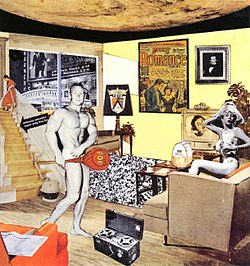
The idea for collage came from Richard Hamilton, a member of the Independent Group, who created collages from American advertisements such as Just What Is It That Makes Today's Homes So Different, So Appealing?
Week 2
Art
Lichtenstein Lawsuit for GagosianI saw this headline and it caught my attention. I'm taking a Pop Art and Fluxus class, so Lichtenstein has been coming up a lot in my reading. Apparently, the Gagosian Gallery in New York is being sued by an art collector, Joan Cowles, over a Lichtenstein painting. The collectors son sold the painting without her consent to the gallery, who then sold it for 2 million dollars, reportedly less than it's market value, and now the collector is sueing Gagosian for 10 million dollars and accusing the gallery of "such wanton dishonesty as to imply criminal indifference to civil obligations, with reckless disregard of Cowles’s rights." The gallery denies the accusations and claims that they did not know at the time of purchase that the son did not have permission to sell the painting.
A lot of our discussion in the Pop Art class has centered around the distinction between Pop Art, with a capital P, and commercial (popular) art. The Smithson’s called for fine art to compete with pop art, and perhaps this means appropriating the qualities of pop art. I think the commercial success of Pop Art proves that it did just that, but the comodification of these artworks also brings into question whether they can be considered Fine Art objects at all.
Thinking
The Birth Of TragedyIn preparation for the lecture on Thursday, I read the introduction of Nietzsche's The Birth Of Tragedy. The link includes the whole text. The central idea proposed by the text is that art is motivated by two factors, personified by Greek gods. Apollo becomes Apollonian art, or the plastic arts, and Dionysus becomes the Dionysian, paired with music. Greek tragedy marries the two forces to create ideal art. Nietzsche explains the two forces as dream and intoxication as well. Apollonian arts emerge from the fantastic, idealized dreams of the artist. Apollo, the god of brightness, is also the god of fantasy. The Dionysian then is linked with intoxication. He associates this with the “tremendous awe which seizes a man when he suddenly doubts his ways of comprehending illusion.” The Dionysian is a more spiritual experience with nature, and life. Active and emotional next to the controlled intelligence of the Apollonian.
Nietzsche claims that the best art marries these two forces, and the most successful marriage of the two is in fact the Greek Tragedy. He acknowledges both as art, but believes that one without the other is less valuable than both.
Social Change
ACTA SummaryACTA Video
After all of the hype over SOPA and PIPA which failed in congress last week after major sites like Reddit, Wikipedia, Imagur, and Craigslist went black for 12 hours in protest, the internet is turning to an older bit of legislation, ACTA, which would be implemented on a larger scale. The summary (which is, ironically, from Reddit) includes a link to the source material, gives an overview of the bill, focusing on what it would actually do. The author of the post emphasizes the fact that what makes the bill dangerous is not what it legislates, but what it would allow governments to legislate. Under ACTA, bills like SOPA and PIPA would be able to be passed.
The hype ACTA is recieving is misleading. While it is dangerous, and definitely compromises free speech and file sharing, and having farther reaching consequences in farming and healthcare, the bill itself does not implement anything, it simply makes it possible to. The video is very well made, but I don’t think it is particularly informative. It provides ‘what if’ scenarios, but does not adequately explain how the bill works to enable these possible scenarios. I will pursue these issues in further posts.
Thursday, January 19, 2012

Week 1
ART
Modern Art Improves Quality of Life for Alzheimer's PatientsLooking at art can improve the quality of life for people with Alzheimer’s, studies show, because patients continue to have emotional responses to art, which trigger memories. The program was started at the MoMA in 2006, with tours of all Alzheimer’s patients. It was part of an initiative to reach underserved audiences, such as the deaf and blind. A keynote speaker at a summit held to create the program encourages us to “stop thinking about Alzheimer’s as a death sentence, and start looking at it as we would any other chronic condition.” On the tours, Alzheimer’s patients are not treated as a special needs group, and the action of looking at art helps them recall memories, which increases their quality of life.
This article reminds us that there is something about art which encourages creative thinking and establishing connections. Viewing and discussing art is beneficial for everyone, and it is unfortunate to see it constantly cut from school programs. It’s great to see research and instances which remind us of the importance of art.
THINKING
Waking Life Since this movie covered a lot of ground, I’m picking out one of my favorite scenes and going from there. I like this scene, because it points out what a lot of people ignore when they talk about science and religion. People tend to pit the two against each other, when really, they have a lot in common. They both seek to understand how the world works, and in the case of free will they both struggle to explain it. Religion fails to explain free will in the face of an omnipotent God, and physics fails to explain free will in a world of predictable chemical and physical reactions.
The speaker explains, simply, how our movements are controlled; electrodes fire in the brain and send a pulse through the nervous system, which causes a muscle to contract. He states that each of these actions and reactions can be explained with basic physics. I don’t know enough about it myself, but I would be interested to see what starts the chain in the brain. I guess that’s the tricky bit, because that’s when we, make decisions. Or are all of our actions simply reactions to the problems placed in front of us. What about thoughts, which never manifest themselves into actions?
SOCIAL CHANGE
“Information Diet” on NPR“If we want to make media better, then we've got to start consuming better media,” says Clay Johnson, author of “Information Diet.” I saw this headline on NPR’s front page, and was immediately interested in how Johnson was able to transpose the language and logic of obesity and dieting onto the consumption of media. It’s a really straight forward interview, and I think this line of thought is especially important in the Internet age, when we, the consumer, have the power to choose what we watch, see, and hear online. We are not limited to the two news stations we get on our television, and the paper that comes every morning. (In fact, I don’t think I know anyone my age who regularly watches news on TV or gets a newspaper daily). We get our news online, via twitter feeds, facebook, and reddit. Johnson explains how media sources cater to the desires of their readers, which often comes at the cost of quality, informed news stories. If we want better news, we have start looking for better news. Stop sifting through ads, and clicking on the first thing that catches your attention. Johnson suggests staying as close to the source, and as far from opinion, as you can. For example, if looking at legislation, try to find the bill instead of reading someones opinion on the bill.
Subscribe to:
Posts (Atom)